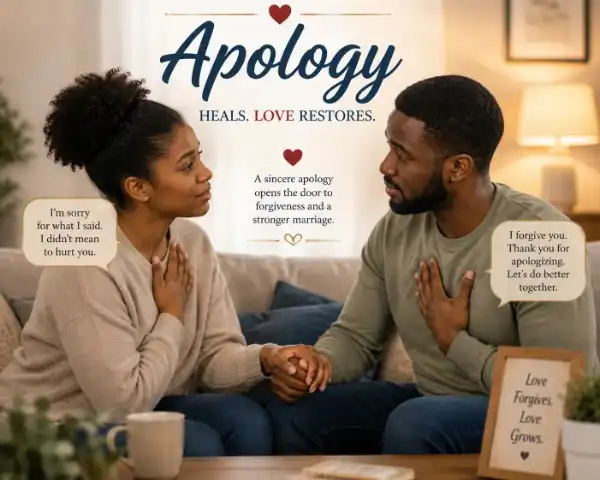
Emotional Validation in Marriage: Why Feeling Heard Matters

In every marriage, couples have moments when one tries to explain how they feel, but instead feels rejected and more alone than before the conversation started.
This is usually not caused by disappointment itself; it is caused by the response that follows. A wife told her husband that she felt embarrassed in front of her friends, and the husband told her she was overreacting. A husband knew he felt overlooked during a stressful week, and his wife didn’t waste the time to tell him why he was wrong to feel that way.
From both cases, you will realize that these couples are not truly fighting in any way. They are struggling with something deeper: a lack of emotional validation in marriage.
Many communication problems couples have are not caused only by what they said, but by how they responded to what was said. The foundation of emotional validation in marriage means that people are already aware that their feelings come first to the one they love before they discuss any solution.
This is also one of the skills most couples overlook in long-term relationships, and we will learn them side by side in this post.
What Emotional Validation Really Means in Marriage:
Emotional validation at its core means discovering and acknowledging someone’s emotional experience. It is the act of letting your spouse know that their feelings matter to you, even when you didn’t react the same way.
Emotional validation in marriage is never about deciding whether a feeling is logical, but about accepting that the feeling is real for the one experiencing it.
This is where many couples miss it. Validating a spouse does not mean:
Emotional Validation In Marriage is not about deciding whether a feeling is logical. It is about accepting that the feeling is real for the person experiencing it.
Agreeing with your spouse in everything.
Accepting blame for what you know you didn’t cause. Declaring that your partner is always right.
Giving up your perspective or feelings.
Avoiding a difficult conversation because you want peace to reign.
Validation only communicates these simple things: It says, “I hear you.” It says, “Your feelings matter to me.” It says, “I want to understand what this experience was like for you.” When these three messages are delivered consistently, they can change the emotional climate of an entire marriage.
Why Feeling Heard Matters So Much:
People like to open up more when they feel heard. A spouse who feels that their partner is genuinely listening will like to share more honestly, without being defensive and with less fear of judgement.
However, when a spouse feels dismissed consistently, the results are predictable: emotional distance, resentment, and repeated arguments about the same issues or silence.
Sometimes, a partner is not asking for a quick fix. A wife who is expressing her frustrating day at work knows quite well that the husband cannot solve the problem.
She may simply want the husband to understand how she felt during the day. A husband venting his frustration with a family member may not want advice, but that the waive may know that the situation was not easy.
When couples fail to understand these differences, even well-meaning advice can feel like dismissal, even when that’s not the intention. This is usually the exact moment when emotional validation in marriage becomes more helpful, simply by pausing to acknowledge the other person’s feelings before trying to bring a solution.
Validation Builds Emotional Safety:
Emotional safety is simply the feeling that you can share your thoughts and feelings without being ridiculed, corrected, or shut down. A spouse who feels emotionally safe will be more willing to share their fears, insecurities, and unmet needs.
Emotional safety and healthy communication go hand in hand. When a spouse learns over time that they are well understood and not criticized, they become more willing to share small frustrations before they become overwhelming.
This is one of the subtle but powerful benefits of consistently practicing emotional validation in marriage rather than only during major arguments.
Validation Is Not the Same as Agreement:
You must understand the differences between validation and agreement. Couples get stuck at this point; that’s when a husband can say, “I understand why you feel hurt,” without ever saying, “You are completely right about everything.”
Validation is all about recognizing the emotions, while agreement is the interpretation, the facts, or conclusion.
A wife might believe that their husband forgot their wedding anniversary on purpose, while the husband insists it was never intentional. He does not have to accept her interpretation to validate her feelings. He can say, “I can see why that felt hurtful to you, even though I never meant to hurt you.”
This is the very heart of emotional validation in marriage, where two people can see a situation differently and still honor each other’s emotional reality.
What Invalidates Your Spouse’s Feelings:
The ways you respond to your spouse, even without any intention to harm them, can shut down even honest communication. For example, telling your spouse “you are too sensitive,” “it’s not a big deal,” or “you always complain” sends the message that their feelings are not worth understanding.
Phrases like “you are overthinking this,” “you misunderstood me,” or “you should just move on” carry a similar effect, even when you are potentially saying it to end an argument peacefully.
These responses do not always mean to be cruel. The issue is that you answer the words and not the emotion behind them, and when a spouse is repeatedly met this way, they will stop sharing altogether. Silence may sometimes look like peace, but it consistently shows that emotional validation has disappeared from the marriage.
How to Validate Your Spouse During Difficult Conversations:
Just like any other skill, emotional validation in marriage can be improved with intentional practices. A few habits can also be helpful during difficult conversations.
Start by listening without preparing your defense immediately, and try to understand the emotion behind the words rather than only the words. Understand what your spouse seems to be experiencing before you respond with your own perspective.
Reflect what you understand from your spouse also, so your spouse will know that you understood them clearly. Ask them questions when you are not sure what they mean; don’t assume, and resist the urge to rush into fixing the problem. Respond even when you disagree.
There is no perfect formula to do this. Marriages are made up of imperfect conversations, and just a small shift towards understanding the feelings before defending yourself can make your conversation much better.
None of this requires a perfect formula. Marriages are made up of imperfect, human conversations, and even a small shift toward acknowledging feelings before defending yourself can change the tone of an entire discussion.
What to Say When You Do Not Agree:
One of the skills that’s worth learning in marriage is how to validate a feeling even when you disagree with the situation. The examples below will show you how this works in real conversations.
“I see why you felt ignored, even though that was not my intention.” “I understand why that upset you. I remember it a little differently, but I do want to understand your side.” “I may not see it exactly the way you do, but I can see that it hurt you.”
Each of these responses will allow each couple to keep their own perspective and still not turn the conversation into a contest. This is usually the most actionable form of emotional validation in marriage because most of the arguments involve two honest but different perspectives.
Understanding how to phrase disagreement in this way is one of the habits to build, since it protects the relationship and each person’s honest point of view.
When Validation Changes the Way Couples Communicate:
When validation is practiced consistently, it can gradually reshape the overall ways of communication in marriage. Genuine understanding can replace defensiveness; blame can soften into acknowledging why a spouse feels a certain way. Silence can open into honest conversation, and optional distance can gradually give way to closeness.
Note that none of these means that there are no more disagreements in your marriage, because every marriage will always face challenges. What changes is how couples move through those moments together. That shift is also one of the visible long-term benefits of emotional validation in marriage.

Make Validation a Daily Marriage Habit:
Emotional validation should not only be practiced during major arguments. It is crucial in ordinary moments like recognizing disappointments over cancelled plans, acknowledging genuine stressful day, or simply asking how a situation affected them emotionally.
If you can build this habit into your daily life, you will find that emotional validation in marriage feels far more natural during hard conversations, as it is no longer reserved for crisis moments only.
The Goal Is Connection, Not Winning:
Healthy marital communication is not to prove who is right in every exchange, but to understand each other well enough to protect the relationship while still dealing openly with the real problems. A spouse who feels heard is very likely to stay open, and openness provides a genuine opportunity to work through problems as a team.
This is one of the ultimate purposes of Emotional validation in marriage, which protects the relationship even in the middle of heated moments.
Conclusion:
No marriage is sustained by winning every argument or being right about everything. They are sustained only by two people who also show each other that their feelings are recognized, even during arguments. Your spouse does not always need an immediate solution.
What is needed is to know that their concerns have been heard and that it matters to the person they love.
Practicing emotional validation in marriage will not solve every challenge in a relationship, but it can change how those conflicts are handled. Any time your spouse shares something difficult, pause for some time before you respond. Always try to understand the feelings beneath their words. That single pause may be the beginning of a more connected marriage.
What is emotional validation in marriage?
Emotional validation is the act of understanding and acknowledging your spouse’s feelings as real and understandable, even when you didn’t see the situation the same way: it focuses on the emotions underneath their words, instead of agreement with their conclusions.
Why is feeling heard important in marriage?
A spouse can feel emotionally safe when they feel heard in their marriage, and it encourages honesty, reduces defensiveness, and improves trust over time.
Without this, couples usually experience resentment or repeated unresolved arguments.
Does validating your spouse mean agreeing with them?
No. Validation means accepting that a feeling is real and understandable. You can validate your partner’s emotions even while they hold a different opinion about the facts or the situation.
How do you validate your spouse’s feelings?
The best way to do that is to practice listening without trying to defend yourself. Always try to understand the emotion behind their words, and reflect what you hear rather than assuming you already understand.
What should you say when your spouse is upset?
These responses will show that you are actively listening to their emotional experience, not just what they are saying.
What happens when a spouse constantly feels unheard?
If you leave it without trying to listen to them, they may stop sharing anything with you and withdraw emotionally. When feelings are consistently dismissed, it can quietly erode trust and disrupt closeness in your marriage.
How can couples improve emotional communication?
The best and easiest way to improve emotional communication in marriage is to practice small, everyday acknowledgement of each other’s feelings, rather than saving validation till disagreement times.
This will help you and your partner build a habit of understanding that helps you when having harder conversations.