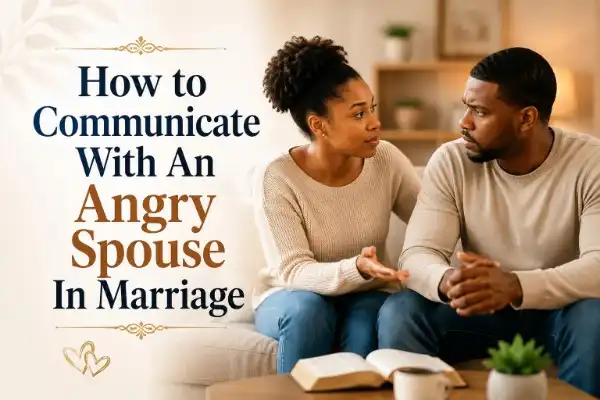
How to Communicate With An Angry Spouse In Marriage

You asked your partner a simple question, and suddenly your spouse’s voice rose in anger. You never expected anything was wrong.
Your heart started beating faster. You tried everything to make them understand what you meant, but every word seemed to make the moment more heated. If you have witnessed such in your relationship, you are not alone.
Many couples find it hard to communicate with an angry spouse, because emotions often overpower logic.
According to relationship researcher Dr. John Gottman, a large share of marital conflicts are issues that don’t fully disappear but can be managed through healthier communication habits.
Studies on marital dissatisfaction also show that poor conflict communication is one of the leading contributors to relationship challenges.
Thankfully, you can learn right communication techniques that will help you reduce unnecessary conflicts and strengthen emotional safety, which will help you resolve disagreements easily and more effectively.
In today’s guide, I will open your eyes to practical, faith-informed ways to communicate with an angry spouse in your relationship even when emotions are very high.
What Makes a Spouse Angry?
Anger usually comes out of nowhere, and it mostly builds from the combination of pressures like
- Stress from work
- Financial pressure
- Emotional wounds
- Unmet expectations
- Poor communication habits that build up over many years.
- And feeling unheard.
A renowned therapist, Dr. Sue Johnson, explains that anger covers deeper feelings like hurt, fear, or loneliness. When you recognize anger as a signal instead of an attack, it will help you always respond with compassion instead of being defensive.
Why You Should Never React to Anger With More Anger:

When you react to your partner’s anger with anger, it will cause both of you to enter what Dr John Gottman calls “flooding.” This is a state where the nervous system is so overwhelmed that rational conversation becomes almost impossible. That is also when:
– Your partner can activate their defensive response
– Small disagreements gravitate to big ones quickly.
– Trust becomes eroded with every disagreement.
– Emotional intimacy suffers long after the argument ends.
Responding to every disagreement with matching intensity will make things worse. Learning the best way to communicate with an angry spouse in moments of calm, rather than reactively, will keep the flooding cycle from overwhelming your relationship.
Signs Your Spouse Is Too Angry to Have a Productive Conversation:
Timing is as important as wording, so be careful to know the best time for problem-solving. The signs below will guide you:
– When there’s a raised voice
– Refusing to listen or engage.
– Walking away in the middle of your conversation.
– Personal attacks rather than specific complaints.
– Choosing to blame instead of describing.
Trying to solve the problems when you see these signs usually makes things worse.
Note that waiting for a calmer moment is not avoidance but wisdom, and it’s often what differs between a conversation that helps and one that makes it harder to communicate with an angry spouse going forward.
How to Communicate With an Angry Spouse Successfully:
The principles I will share with you in this section work together, but none of them require timing or a script, just consistency.
Each of them is a piece of the larger skill of how to communicate with an angry spouse without losing your emotional footing.
Stay Calm Before You Speak:
Let your nervous system shape the tone of your conversation. Always take a moment to stay calm and think before you speak.
– Don’t raise your voice when speaking; calm words make things easier.
– Maintain gentle eye contact throughout the conversation.
– Control your breathing with calm, deliberate breaths.
– Never try matching your partner’s emotional intensity.
Proverbs 15:1 says that ” A gentle answer will turn wrath away.” This principle is highly supported by the latest research, and it’s also the first actionable step to communicate with an angry spouse without causing more issues.
Listen Before Defending Yourself:
Active listening is all about putting your own explanation on hold for some time so you can hear and understand what your spouse is saying. It also means:
– Validating your spouse’s emotion, even when you strongly disagree with them.
– Never interrupting them, even when you feel misunderstood.
– Not relying on assumptions, but asking clarifying questions to understand their intention.
From Gottman’s research, we understand that persuasion can help you resolve conflicts, no matter how hard it seems.
Choose Words That Reduce Tension:
Your choice of words can either cause more issues or help calm the situation. Consider the difference:
Instead of “You always overreact,” try “I understand you’re upset.”
Instead of “Calm down,” try “Help me understand what’s hurting you.”
A little change in your phrasing can change the trajectory of that hard conversation, and they are one of the easiest ways to communicate with an angry spouse without triggering a defensive reaction.
Focus on One Problem at a Time:

Most times, we feel like bringing every past hurt into any single argument, but it always backfires. So never:
– Bring up past and unrelated mistakes during arguments.
– Compare your spouse to others.
– Generalisations like “you never,” “you always”
– Avoid attacks on character instead of behaviour.
Focus on the current issue until you can solve it.
Use “I” Statements and avoid accusatory statements entirely:
Using accusatory language during conversations will trigger defensive responses almost immediately. Compare “I felt ignored” to “You never care.” The first calls for empathy, while the second invites counterattack.
Communication psychology always shows that “I” statements lower defensiveness and open the door to real dialogue.
Know When to Pause the Conversation:
Sometimes the most amazing thing you can do to have good communication with your angry spouse is just stop talking, especially when emotions are high. That short break will allow your individual nervous systems to reset. Consider:
– Observing a 15-minute break so your cortisol levels will come down.
– A quiet time and meditation in the Word of God.
– Have a deep, slow breath in…
– Take a little time to clear your head.
Doing these will help you return to the conversation with steadier emotions rather than letting the issues disappear entirely. Pausing for a while doesn’t mean you have given up; it’s the wisest way to communicate with an angry spouse without letting it boil over.
Avoid These Common Communication Mistakes:
Some habits can do more damage during disagreement than anything else. Watch out for
– Sarcasm.
– Name-calling.
– Yelling.
– Threats.
– Silent treatment.
– Mocking.
Each of these can destroy trust in such a way that it can be almost impossible to repair the argument itself. Avoiding them is very important if you want to genuinely communicate with your angry spouse.
Reassure Your Spouse During Difficult Conversations:
Even in the height of tension, reassuring your spouse of your love and care for them will keep the foundation of a relationship safe and strong, especially when you use simple phrases like:
- “I’m on your side.”
- “We’ll solve this together.”
- “I love you.”
Attachment theory says that having the sense that the relationship itself is not at risk makes it easier to resolve the disagreement faster.
What If Your Angry Spouse Refuses to Listen?
There are times when you will try all you can, yet your spouse won’t still engage. In that situation, here are a few things I suggest you do:
- Avoid pushing harder to have them converse with you. Respect their boundaries.
- Don’t force them into any discussion they are not ready to have.
- Keep cool until their emotions have settled down.
- Suggest you go for counseling if the issues repeat consistently.
Sometimes the best way you can communicate with an angry spouse is to withdraw for some time, so your relationship can breathe before trying again.
When Anger Becomes Emotionally or Physically Abusive:
There are great differences between normal marital challenges and abuse. Frustrations and shouting are part of normal marital conflict, while intimidation and physical aggression are not.
If you feel unsafe, I will advise that you reach out to a professional, pastor, or local support service for help rather than managing the situation alone.
Biblical Wisdom About Speaking During Conflict:
Scripture provides quality and evergreen guidance on how to have hard conversations. In verses of the bible, such as:
– Proverbs 15: 1 says, “A gentle answer turns away wrath.”But a harsh word stirs up anger.
– James 1 verse 19 says My dear brothers and sisters, take note of this: Everyone should be quick to listen, slow to speak, and slow to become angry.
– Ephesians 4:29 — Let no corrupting talk come out of your mouths, but only what builds others up.
– Colossians 3:13 — Bear with one another, and forgive one another.
You will not only have practical strategies you can follow, but you will receive spiritual guidance that aligns better with research on modern ways of resolving conflicts.
Final Thoughts on How to Communicate With an Angry Spouse:
One of the things I will implore that you to take more seriously from this guide is that you can communicate with an angry wife in a way that can heal your marriage rather than harm it. As Ike said before, anger is not always the enemy, but how you respond to anger.
When you fully understand how to communicate with an angry spouse with empathy and wisdom, it will transform all your conflict into an opportunity to understand each other more deeply and connect effectively. Practicing these consistently will give you faster results than waiting for overnight perfection.
Frequently Asked Questions:
How do I communicate with an angry spouse without starting another argument?
The best way to do that is to learn how to be calm, listen attentively, and find the right timing to have that conversation. Also, use respectful language and never react emotionally. Small and consistent changes in approach will prevent most of the heated moments from escalating further.
Should I stay silent when my spouse is angry?
Giving space and using silent treatment are two different things that will give you different results when you are trying to communicate with an angry spouse.
What should I never say to an angry spouse?
Avoid using any phrase that can escalate your conflicts, such as “You’re overreacting” or “You always do this.” These are the type of statements that dismiss feelings and cause blame that can hinder resolution.
How long should I wait before discussing the issue again?
Observing just a 15-minute pause to a few hours is enough for emotions to settle. Waiting too long can turn a pause into looking like avoidance. Therefore, aim to resolve whatever argument the same day by revisiting the conversation when possible.
Can marriage counseling help couples communicate with an angry spouse more effectively?
Yes, marriage counselling can help you learn how to communicate better with your angry spouse, especially the Evidence-based counselling approach developed by Dr. Gottman.