Strangers In Marriage: 7 Devastating Relationship Mistakes

By a Relationship Specialist | Reviewed by Licensed Marriage Therapists | 12-Minute Read
You made your marriage vows to the one you love so dearly. But between the wedding toast and the Tuesday-night silence, something shifted.
You stay under the same roof, share the same bed, maybe have children, yet you feel like a couple who have become strangers in marriage, and this is not the category you ever expected to join.
You prefer to scroll your phone at dinner because your conversation feels forced, you even find it hard to remember the last time you laughed so hard, and you wonder: Is this what your marriage has become?
The answer is no. But also a mind-bugging yes, for couples who never saw it coming.
In 2023, a study published in the Journal of Marriage and Family revealed that over 60% of divorces are initiated due to a slow, creeping emotional distance, rather than dramatic betrayals.
So many couples are growing apart so gradually that they didn’t even notice until it nearly destroyed their marriages. Your love didn’t fail in a day; it started drifting in inches.
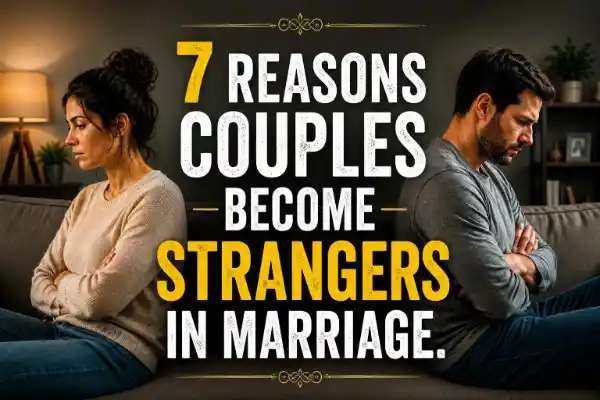
In this post, I will break down seven overwhelming reasons couples become strangers in marriage, with expert-backed strategies, real-life examples, and a clear roadmap to reconnect before the distance becomes wider.
1. The “Arrival Fallacy” — Why Many Couples Stop Investing After the Wedding:
The first culprit of when couples become strangers in marriage is what Dr. Tal Ben-Shahar describes as the Arrival Fallacy. This is the subconscious belief that reaching a major milestone in marriage means the hard work is over.
Couples do everything to have a successful wedding, but never give a second to planning their marriage itself.
All they did at the earliest stage of their relationship, like courtship, date, the intentional effort to impress each other gradually disappears, and has even been replaced by a shared routine that slowly suffocates the connection.
After research, the Gottman Institute shows that couples who stop making regular sacrifices for emotional connection have a measurable decline in marital satisfaction within 18 months of marriage.
The Real-Life Pattern Looks Like This:
| Stage. | Behavior During Dating | Behavior After Marriage |
| Communication. | Daily Check-ins. Long conversations. | Quick logistical texts (“Buy milk”) |
| Date | Planned, intentional, exciting. | Rear, or replaced by Netflix. |
| Affection. | Spontaneous, frequent. | Asking deep questions. |
| Curiosity. | Asking deep questions.. | Assuming you already know everything. |
| Effort | Dressing up, making plans. | Comfort defulting. |
Behaviour after dating.Planned, intentional, exciting.
You don’t need grand romantic gestures to fix this; you only need to introduce the micro-investments you made during the dating, like unexpected romantic text messages.
2. Communication Collapses Into Transaction — When “How Was Your Day?” Is Just Nois:
One of the most painful signs that a couple could become strangers in marriage is when their conversations shrink to logistics. “Did you pay the electric bill?” “What time does Zara’s recital start?” “Can you pick up dinner?”
These are not conversations at all; they are project management. Dr.John Gottman, a renowned marriage researcher, identified this as”parallel living.”
His four-decade longitudinal study discovered that couples who use transactional language reported being” lonely in marriage, at almost twice the rate of couples who continued with emotionally expressive dialogue.
The sad truth is that the more stressful life becomes, the more couples stop having deep emotional conversations, especially when they need it most.
Template: The 15-Minute Reconnection Conversation
Try having structured check-ins, three times a week:
High of the day: “What was your best moment you had today?” (3 minutes)
Low of the day: “What drained you or frustrated you?” (3 minutes)
Emotional weather report: “On a scale of 1–10, how connected do you feel to me right now?” (3 minutes)
One wish: “Is there anything you need from me this week that you haven’t asked for?” (3 minutes)
Appreciation: Each of you should name one specific thing you noticed and appreciated. (3 minutes).
This may look simple to you, but when you practice it consistently, you will have one of the most evidence-backed tools to prevent emotional strangers from forming under the same roof.
3. Unspoken Resentments That Calcify Into Walls — The Slow Poison No One Talks About:
When you ask any marriage therapist what subtly destroys marriages, you will be surprised to get one common answer, which is accumulated, unexpressed resentment.
When couples become strangers in marriage, there are almost always so many unspoken grievances underneath the surface.
Dr. Sue Johnson described these resentments as “protest behaviors,” for example, small acts of withdrawal. When they are left unaddressed, they don’t dissolve, but calcify.
Calcified resentment not only creates distance, but it also requires history and causes partners to reinterpret even good memories as suspicious.n
The Resentment Audit, A Practical Exercise:
- Individually, each of you should answer these questions in writing, then share.
- Name three times you felt dismissed or unimportant and refuse to say it out.
- What is one expectation I have that you may not even know about?
- What would make you feel very respected in our marriage?
Sharing these answers with a therapist if needed is distressing. It is also one of the best ways to dissolve the walls that make couples feel like polite strangers in marriage.
4. The Invisible Labor Imbalance — How Inequality Breeds Emotional Exile:
One of the statistically driver of couples becoming strangers in marriage that is often less talked about is inadequate distribution of both domestic and emotional labor.
Research from the Pew Center in 2021 shows that even in dual-income households, women engage in an average of 2.8 more hours of unpaid domestic labor every day than their husbands
However, this is not exclusively about men or women. Whenever any couple bears more responsibilities, like remembering birthdays or planning family activities, it slowly results in resentment.
The weight-carrying partner feels tired and stressed, and the other does not even realize the imbalance. With time, the partner stops trying to connect emotionally after feeling exhausted, because they have no energy left.
That doesn’t mean their love for the partner has ended; they simply become emotionally drained.
The Invisible Labor Audit Table:
Category Who Currently Does It Feeling It Feeling It Creates Scheduling appointments Managing children’s school communications Remembering family birthdays/gifts Initiating social plans Emotional support after hard days Household grocery tracking Financial planning & bill payment
Fill this table together honestly. The goal isn’t accusation — it’s visibility. What you can see, you can redistribute.
5. Parallel Lives Online; How Screens Are Replacing Spouses:
We all appreciate the awesomeness of digital technology, but the truth is that it has brought an entirely new mechanism that has helped so many couples become strangers in marriage.
An average adult now spends more than 7 hours every day on screens, and a significant portion of that time is spent in the physical presence of a partner. According to Sherry Turkle, a relationship researcher, in her seminal work titled “Alone Together,” called it “phubbing,” which means phone subbing your partner.
She also documented how the presence of a phone on a table during dinner reduces the depth of conversation and emotional intimacy.
The 30-Day Screen Boundary Experiment:
- No phones at the dinner table. Make this non-negotiable.
- One “analog evening” per week: no screens after 8 PM.
- Charge phones outside the bedroom.
Create a shared “discovery list” like podcasts, documentaries, that you can experience together, which also gives you new things to discuss.
Couples who implemented these structured screen boundaries in 2022, as reported from the University of Arizona study, reported that they had 23% improvement in perceived relationship satisfaction within six weeks.
6. Identity Erosion — When You Lose Yourself and Resent Your Partner for It:
One of the profound but underappreciated reasons why couples become strangers in marriage is individual identity erosion. This is all about the quiet disappearance of self that happens when two people come together completely.
Marriage, shared financial obligations, and parenthood can overshadow the hobbies and the passions that made each partner who they are in the early stages of their marriage.
A renowned psychotherapist and author of Mating in Captivity, Dr. Esther Perel, argues that desire requires otherness. When both partners lose their individual identities to a shared unit, the spark becomes dim or disappears completely.
At this stage, there’ll be no more longing, no”I want to know you more, because there’s no one separate or interesting.
Practical Identity Restoration Plan:
- Each of you should identify one personal interest you’ve abandoned since marriage.
- Block one weekly ” solo pursuit hour” and protect it. Make it non-negotiable.
- Maintain at least one friendship independent of the couple unit.
- Set one personal goal per quarter that’s not related to marriage or family.
Paradoxically, two complete individuals make a far healthier marriage than two halves who have dissolved into each other.
7. Crisis Without Repair — The Turning Point That Never Gets Processed:
Every marriage goes through one or more issues, ranging from job loss, grief, betrayal, or financial issues. How, let me let you know that these events are not in themselves what make couples strangers in marriage, but their failure to process and repair together after the crisis.
Dr. Janice Kiecolt-Glaser’s research at Ohio State University discovered that couples who experience major challenges without engaging in collaborative coping have more elevated levels or relationships dissatisfaction and emotional withdrawal within 12-24 months after the crisis.
They were able to survive the raging storm, but were gradually drawn into the aftermath, before they understood how to say: “That was hard, and I think it changed us, and I want to find each other again.”
The Post-Crisis Reconnection Framework:
Name it: “I think all we passed through last year created distance between us.”
Validate it: “I imagine it was hard for you in ways I didn’t fully fathom.”
Claim it: “I’ll want us to find our way back to each other.”
Plan it: Schedule to have a session with a couples therapist, not because your marriage is dying, but because you value it enough to tend it.

Common Mistakes Couples Make When They Notice the Distance:
The moment couples become strangers in marriage, their first step to reconnecting is to recognize the distance, but their response matters too. Many couples complicate the issue, even with their good intentions. Below are the mistakes you shouldn’t make when you are on the journey to rebuild your connection.
Mistake #1 — Using Vacations To Escape Real Problems:
Planning to take a trip together without addressing the underlying disconnection is a waste of time, because this issue will still be there until it overwhelms your marriage.
Mistake #2 — Waiting Too Long To Address Emotional Distance:
Don’t wait till your disconnection becomes wider to address it, because there’s no perfect time. Every day you wait is another day the disconnection becomes wider.
Mistake #3 — Blaming Your Partner For The Entire Disconnect
Emotional distance is almost always co-created. However, if you enter it with blame, it will close the doors before the conversation even starts.
Mistake #4 — Expecting One Talk To Fix Everything:
Trying to solve everything in one conversation will make matters worse; the connection is rebuilt gradually and consistently. It is not a single marathon heart-to-heart event.
Mistake #5 — Avoiding Marriage Counseling Because Of Pride:
Getting professional help should be your next step when there’s no improvement with all you have done. Don’t avoid it because of stigma. Many think seeing a couple’s therapist is an indication that their marriage is failing. It is rather evident that your marriage is worth fighting for.
The Stranger-to-Partner Reconnection Roadmap:
For couples who have become strangers in marriage, here is a practical 6-week plan to systematically rebuild your emotional closeness one week at a time.
| Weeks. | Focus. | Action. |
| Week 1. | Awareness. | Complete the Resentment Audit and Labor Audit together. |
| Week 2. | Communication. | Begin the 15-Minute Reconnection Conversation three times weekly. |
| Week 3. | Digital detox | Implement the 30-Day Screen Boundary Experiment |
| Week 4. | Identity. | Each partner identifies one reclaimed personal interest. |
| Week 5. | Intimacy. | Plan one date with zero logistics discussion |
| Week 6. | Profesional support. | Book an introductory session with a licensed couples therapist. |
Conclusion: The Distance Is Not the Destination:
The most disheartening truth when couples become strangers in marriage is that it doesn’t happen because love faded, but because life got loud and they stopped creating spaces to be heard.
It happened in increments so little that the space feels inevitable by the time they notice it.
But a decade of research has shown us that thousands of therapy hours, and the quiet courage of partners who found their feet back, all said that the gap is crossable.
And not that it’s not with grand gestures, perfect conversation, vacation, or date nights alone, but with the daily, unglamorous decision to always choose your partner.
Your next step is not rocket science; it is just to have one conversation. Tonight, have a “phone off” moment together. Look at your spouse now and ask them something you genuinely don’t know the answer to. And mean it.
The marriage you fell into? You can fall back into it with deliberate actions, eyes open, and better than before.
Frequently Asked Questions About Why Couples Become Strangers in Marriage
Q: Is it normal for married couples to feel like strangers?
A. Yes, it is common, but that doesn’t mean they can’t be avoided or made permanent. According to researchers, the majority of couples have at least one significant emotional distance, but those who address theirs have a higher connection rate.
Q: How long does it take to reconnect with a spouse after drifting apart?
A: Most spouses who consistently engage in structured reconnection efforts always have meaningful improvement within 8-12 weeks. Deeper results after a prolonged distance often happen after 3-6 months of couples therapy.
Q: What if my partner doesn’t think there’s a problem?
A: You won’t have to put up a fight if that happens; all you need is to bring data by sharing how you feel. But use “I” language when doing that. For example, “I’ve been feeling disconnected, and I miss us. I’d love to explore that together.”
Never try to blame them. A good therapist can also help you open this conversation in no time.
Q: Can a marriage be saved if couples have become strangers for years?
A: A hundred percent yes. So many marriages have been saved, even when the couples become strangers in marriage for a long period of time.
So reconnection is possible, but you have to be honest, consistent, and be able to seek professional support when necessary.
Emotionally Focused Therapy (EFT) has a documented success rate of over 70% even in very distressed relationships (Johnson, 2019).
Q: Is emotional distance the same as falling out of love?
A: Not necessarily, because emotional distance is a protective response to unmet needs, overwhelming street or accumulated hurt. Love can still be dormant underneath layers of disconnection, and can be overly revived.